The Governance Stack an Analytics MCP Server Assembles Above Supabase so Agents Never Need Raw Access
Four layers let agents query Supabase data without touching production tables.
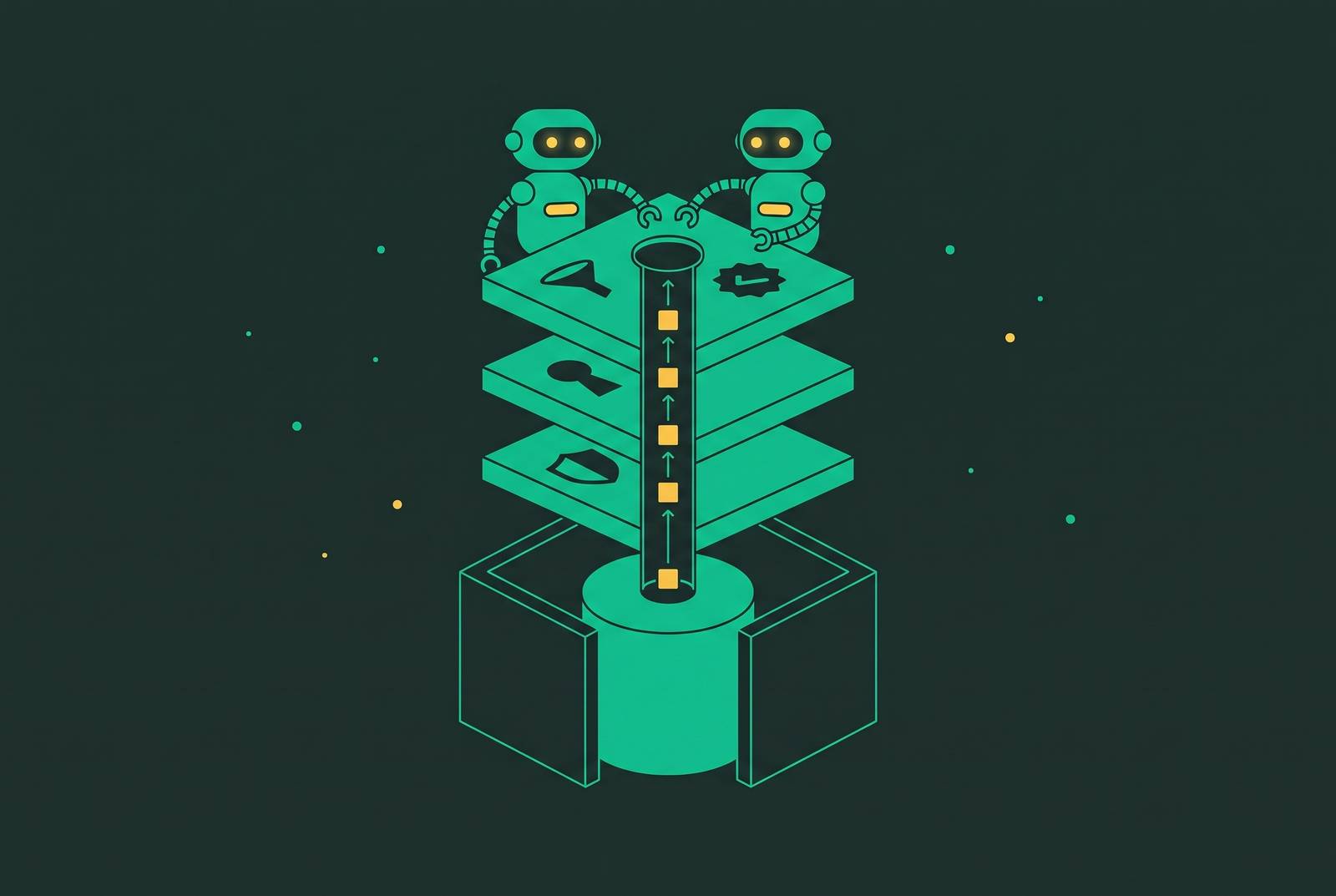
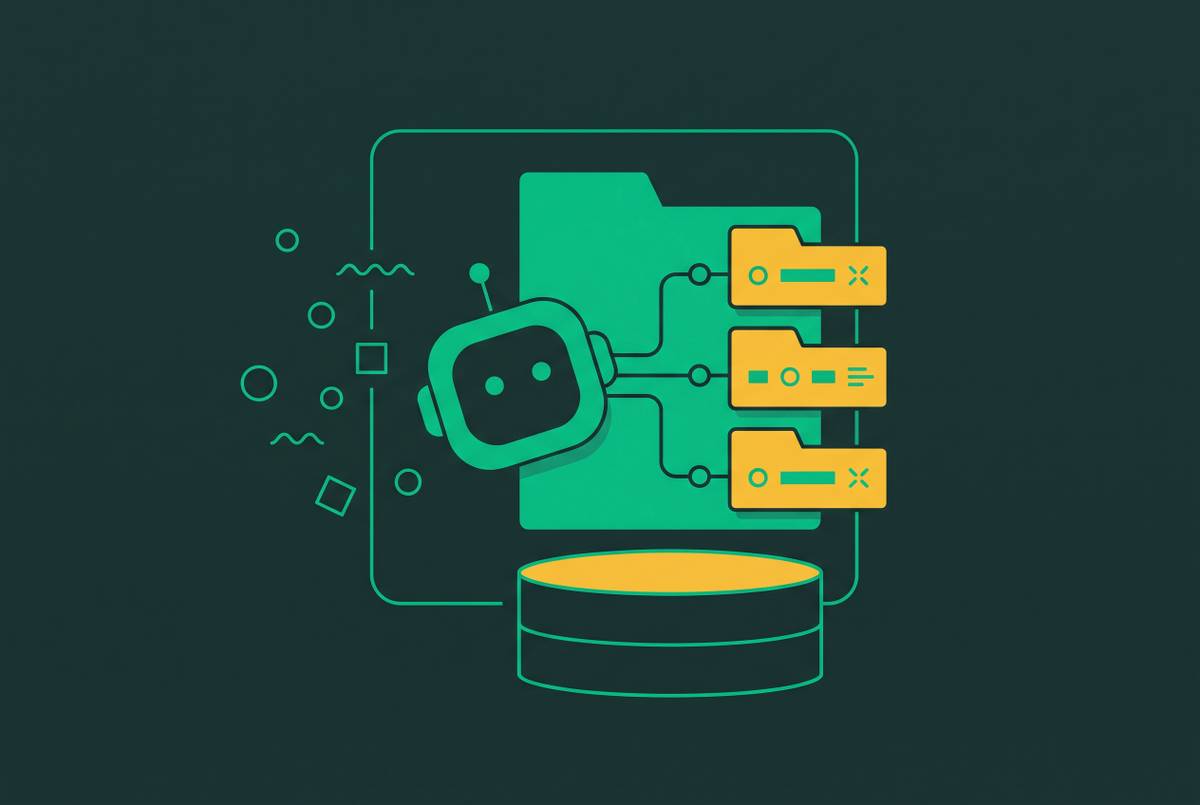
To let AI agents query Supabase data without direct database access, an analytics MCP server should give them access to pre-calculated, governed datasets in place of production tables. That interface needs four layers beneath it, comprising pre-modeled datasets, authoritative metric definitions, query-time access enforcement, and an external audit trail.
Why AI agents querying Supabase directly create a problem that credentials alone cannot fix
A Supabase project with JSONB-heavy tables and ambiguously named columns gives an agent plenty to query but little certainty about what the fields mean. The agent can write valid SQL but choose the wrong measure. Its answer can still look authoritative. Meanwhile, analytical reads compete with application writes on shared compute, so an unreliable answer can also bring higher latency and a surprise on the Supabase bill.
Credentials cannot resolve this ambiguity because authentication establishes permission to connect while leaving the business meaning of a column undefined. Even when an agent is allowed to read revenue-related fields, it still needs a governed definition of revenue. Without one, field selection becomes probabilistic. Restricting the connection can reduce exposure, but it cannot turn that guess into a trusted metric.
Access introduces a second, distinct problem because row-level security designed for application users does not map cleanly onto agent identities. Teams may compensate with broad permissions or workarounds that weaken the original policy. The “God User” anti-pattern gives the agent a single broad service account. A compromised or misbehaving agent can then reach everything that connection permits, without a per-query record tied to the particular agent requesting it.
What an analytics MCP server actually does — and what it deliberately does not do
An analytics MCP server is a governed interface. Anthropic introduced the Model Context Protocol in November 2024 to replace one-off connectors through a separation between the AI client, the MCP server, and the resource. That separation does not govern the resource itself. A connector to raw tables remains a connector to raw tables, however convenient its tools are.
The MCP specification’s July 28, 2026 release added a stateless protocol core and removed protocol-level sessions. Business definitions should therefore not depend on hidden server session state. The server’s role is to connect requests to safe, pre-modeled datasets and their controls, with business logic maintained beyond the server itself.
Layer one: pre-modeled datasets that sit below the server so the agent never touches raw tables
The foundation is a decision about where analytical work happens. Metrics are pre-calculated and stored as governed datasets rather than computed on demand against raw Supabase tables. The agent retrieves a contract before querying. Each metric has a named owner and a versioned definition, giving the request a defined target instead of asking the model to infer one from a production schema.
Those datasets run on a fast, read-oriented engine, with DuckDB over Parquet as the pattern described here. This separates analytical consumption from production OLTP compute. The separation addresses workload contention, while the dataset contract addresses what the agent is permitted to interpret as a metric. Neither benefit comes from placing an MCP endpoint in front of an otherwise unchanged database connection.
Agents, BI tools, and applications can all use the same governed data layer. This is the headless analytics pattern. Data infrastructure is independent of any single front end and available through MCP or an API. A Slack notification, a dashboard query, and an agent tool call can therefore use the same pre-modeled dataset without each recomputing its own version.
Layer two: the semantic layer that gives every metric one authoritative definition
Pre-modeling separates analytical work from production, but it does not by itself settle business meaning. Two stored datasets can still encode conflicting definitions. One engineer writes SUM(revenue), another writes SUM(amount_captured), and their Q2 revenue figures differ materially. The difference may go unnoticed until an investor asks for audited figures. Both calculations can be technically valid even though they answer different questions.
A semantic layer makes the definition authoritative. Metrics such as revenue, churn, NRR, DAU, and health score are defined once and version-controlled, so agent tool calls and dashboard queries resolve against the same certified meaning. The dataset stores the governed result, while the semantic definition governs how that result is produced.
Metrics-as-code makes that authority maintainable through version-controlled definitions whose changes are reviewable and auditable before they affect downstream consumers. For Supabase startup teams, CAC, LTV, monthly churn, ARR, and gross margin are particularly exposed to competing interpretations. Connecting an agent directly to a warehouse does not remove that conflict, because the agent can still write its own SQL against an unsettled definition. Repeatedly plausible but inconsistent answers erode trust in the entire workflow.
Layer three: fine-grained access enforcement that scopes what each agent can see at query time
A correct metric is not automatically appropriate for every requester. The semantic layer defines what an answer means, while query-time enforcement decides who may receive it and which rows and columns it may contain. Identity must survive the full request path. Otherwise, a narrowly scoped agent can acquire broader access simply because an intermediary connects downstream with stronger credentials.
Column-level controls let a marketing agent get campaign metrics from a table while keeping it from seeing customer email addresses in that same table. The MCP server enforces that boundary at the tool-call level, before data enters the result. Row-level filtering similarly restricts a regional agent to its organisational scope. That scope is bound to identity, with agent-supplied region flags excluded from scope decisions.
The confused-deputy failure occurs when the server uses its own elevated credentials to fulfil a request, lending the agent authority it never earned. Token passthrough creates a different exposure. An end-user OAuth token may allow more downstream access than the MCP use case needs. Both differ from simply deploying a broad service account “because the agent might need it,” although all can defeat the intended boundary.
Databricks’ Unity Gateway shows how on-behalf-of access keeps the requester’s identity in agent-to-MCP-server connections. The principle is to evaluate identity, authority, and context together, including who is asking, what they may do, and through which channel. It is not a vendor prescription. The dataset must also be ready for use, so tests and contracts must pass before the server makes the data available. A permitted requester should not receive an unvalidated dataset merely because authentication succeeded.
Layer four: the audit trail that makes every agent query accountable after the fact
Preventive controls describe what should happen, but the audit trail records what did happen. It exposes a bad query that succeeded or a legitimate query that was misused. Every agent-to-server call needs a specific requesting identity alongside any shared service account. Its record also includes the timestamp, connection name, HTTP method, tool called, whether the call acted on behalf of a human user, and whether it succeeded or failed.
The record must extend beyond an isolated database event because an agent workflow can cross several systems. A request may call an LLM, retrieve data through MCP, and then reach an internal API. Unity Gateway extends audit coverage across that chain. Without connected visibility, a team has little basis for establishing who accessed what or whether policy held throughout the workflow.
An external log also prevents the MCP server from being the sole custodian of its own accountability record. This becomes important if the server is compromised. Audit records let teams investigate gaps in definitions, permissions, or their enforcement and verify that a configured control worked. Verifiable governance requires observability.
What breaks when any single layer is missing from the stack
Removing the dataset foundation sends analytical work back to live Postgres. An agent navigating JSONB fields must then infer which raw values represent the requested measure while its query competes with application traffic. Permission checks can limit that query’s reach, and logs can record it. Neither supplies the missing governed dataset.
An agent and a dashboard can consume prepared data yet return conflicting Q2 revenue figures because each uses a different definition. Fast reads do not settle the disagreement. A successful, fully logged request can therefore deliver a number that misrepresents the requested measure.
Without access enforcement, people and agents can reach a correct dataset even when they should not have access to it. A regional agent may get other regions’ rows, or a marketing tool call may return email addresses along with campaign metrics. Valid credentials do not prevent that exposure. Chained tool calls can also combine results in unsafe ways even when each call looks safe on its own.
Removing the audit trail leaves those failures unaccountable after execution. A team may have designed sound policies but cannot establish whether requests followed them or whether an agent exploited a gap. The remaining controls cannot supply missing history.
Full governance is not day-one infrastructure for every seed-stage team. Teams can start with a small scope and still keep the architecture. Five governed metrics are a more manageable starting point than five hundred raw tables, and audit logging is comparatively inexpensive infrastructure. The expensive alternative is retrofitting definitions, identity boundaries, and records after an agent has spent six months operating against production without them.
How Supabase's own infrastructure trajectory points toward this stack
Supabase’s acquisition of Hydra, the team behind the pg_duckdb extension developed in collaboration with MotherDuck, supports the separation between transactional and analytical work. The acquisition is intended to build Supabase Warehouse. Embedded, columnar analytics is thus getting more attention in the ecosystem. That direction fits a governed data layer serving read-heavy analytical requests without making raw production access the default.
Supabase Pipelines moved to Public Alpha with BigQuery support and automatic schema change replication. It detects source-table changes and applies them to destinations. This provides data-movement infrastructure for feeding governed datasets, but movement alone does not define metrics or decide who may read them. The distinction is important because replication and governance solve different problems.
Supabase released Multigres as a v0.1 alpha in June 2026, with horizontal and sharding support planned for a future release. It was not production-ready at launch. As of September 2026, Supabase had not announced a production release, so teams planning for scale could not yet treat horizontal Postgres scaling as a substitute for analytical separation. The platform’s direction supports analytics infrastructure, while semantic definitions, scoped permissions, and audit trails still require deliberate assembly above it.
What a team needs to assemble before an agent gets a tool call
For a team preparing a production agent, the practical sequence begins with datasets and their owners. Metrics should be pre-calculated and stored outside the production database, with a read-oriented engine such as DuckDB over Parquet in the path. Is the tool retrieving a governed dataset, or is it still sending analytical work to live Postgres? An MCP wrapper does not change the answer.
The next decision is whether every exposed metric has a single versioned definition in code, a named owner, and a review process for changes. Access controls follow that definition boundary. Every agent connection needs its own credential with a narrow scope, and row and column filtering must happen before data reaches the tool result. A review must also check whether downstream requests keep the requester’s identity or use the server’s elevated authority.
The audit trail completes the production dependency. Every tool call needs a record of identity, timestamp, tool name, and outcome, together with the other connection and on-behalf-of details required for investigation. That record must be kept outside the MCP server itself. Each layer needs an owner, a scope, and a way to enforce its rules, because talking about governance without putting it in place leaves the data just as exposed.
The AI Governance Institute’s playbook recommends reviewing every MCP server with the rigor applied to granting a new API credential to an employee. Once an agent enters a production workflow, its connector is a production dependency. A maintained allowlist should restrict agents to approved MCP servers, with a documented review before any new server becomes reachable. The same standard applies to an internal analytics server and to third-party connectors, making enforceable governance a requirement for selection alongside connectivity.