Audit Trails and Observability for Agent Data Queries
Agent queries outrun human audit trails, so governance must come first.
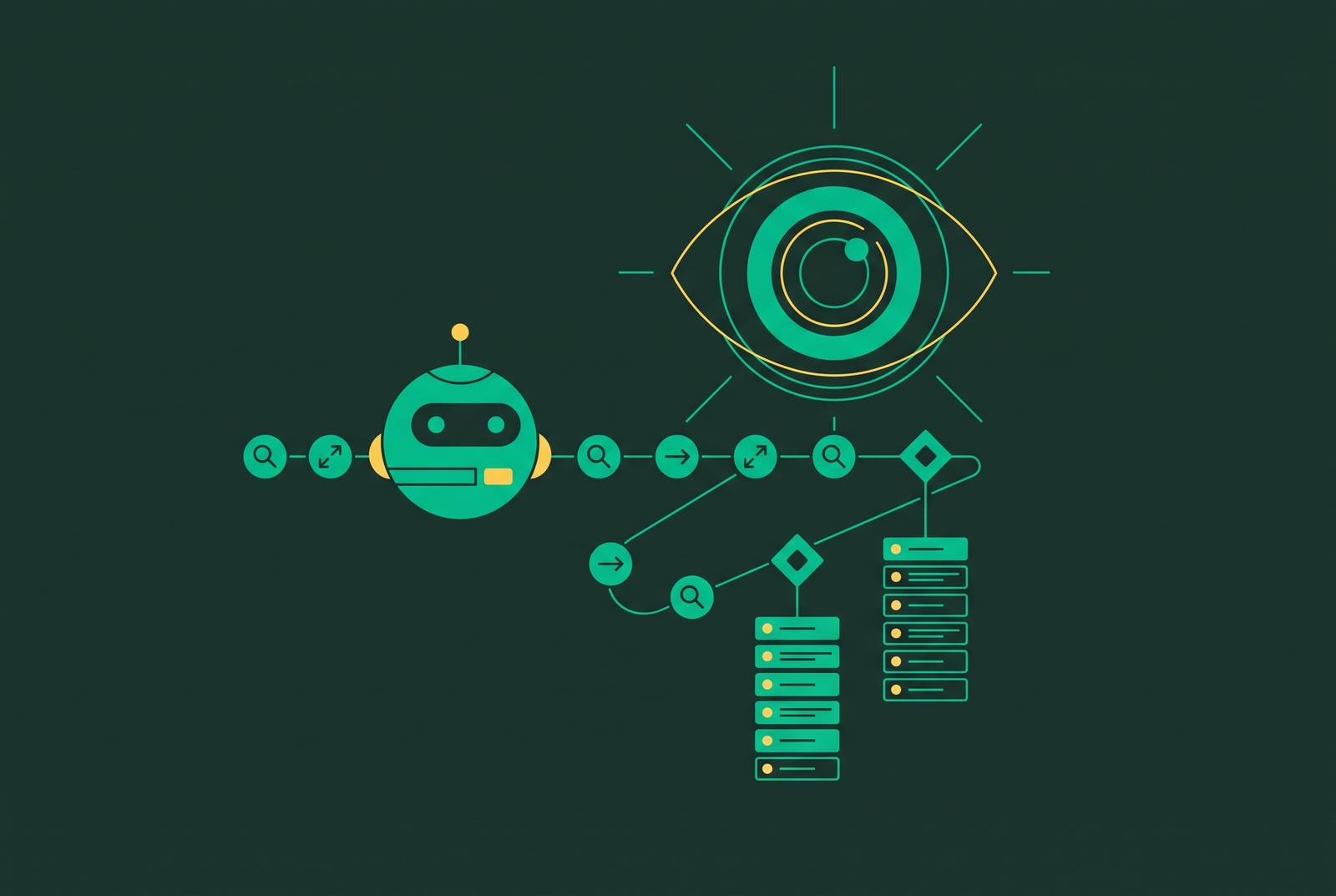
A human analyst who opens a dashboard and writes a query leaves a trail that audit systems were built to follow: one person, one login, one SQL statement, reviewed if anyone ever needs to ask why. An AI agent that chains ten SQL calls across five tables in two seconds, with no person approving any single step, breaks that trail at the root. This piece covers what changes when agents, not people, become the primary consumers of enterprise data, and what it takes to make that access governed and auditable.
Why autonomous agent queries break audit trail assumptions
Audit trails, as most data teams have built them, rest on three assumptions about who's running the query: that a person requested the access, that the request had a specific and reviewable intent, and that the action happened slowly enough for someone to catch a problem before it compounded. Those assumptions held for decades because humans were, in fact, the ones running the queries. An analyst pulling a report works on human time: minutes between keystrokes, a single login tied to a single name, a query written with a specific question in mind. If something looks wrong, someone notices, because a person is sitting in the loop the whole time.
AI agents don't fit that shape anywhere. They query data on their own, without a person approving each call. They run at machine speed, issuing dozens of statements in the time it takes a human to read one result set. Agents do neither. They traverse data at a pace and with a variability that no human reviewer can monitor in real time. The entire premise of catching a bad query before it does damage no longer applies.
The scale of the gap has nothing to do with how many queries an agent runs. No log, however complete, catches that kind of manipulation after the fact. The problem has to be addressed before the query runs, not after.
MCP's acceleration of agent-to-data connectivity without resolving governance
The Model Context Protocol solved a real and specific problem: before it existed, every agent-to-data connection needed its own custom integration, which slowed deployment and, as a side effect, forced teams to think carefully about each connection they built. MCP replaced that friction with a single standard interface that lets an agent reach almost any connected data system the same way it reaches any other. That's a genuine engineering win, but removing the friction also removed one of the informal brakes that used to slow down unsafe access patterns simply because building them took effort.
MCP is fast becoming the common layer between AI agents and enterprise data platforms, but the protocol itself has nothing to say about how safely any given server exposes its data. MCP moves data and the ability to act on it closer to the agent. It does not make the underlying data correct, does not make a query against it safe, and does not make the result auditable on its own. An agent connected through MCP to tables nobody has reviewed or certified will still return a confident, specific, wrong answer, and the protocol has no mechanism to stop that from happening.
A stateless revision to the protocol that arrived in late July 2026 made MCP servers far easier to run behind standard load balancers, which lowered the operational cost of deploying them at scale. Far fewer can intervene while an agent is doing something wrong. Being able to watch an agent act without being able to stop it in time is what MCP's growth has made more urgent, and it's the problem the rest of this piece works through.
The four failure modes that show up when agents query data without governed infrastructure
Connect an agent to a database without governed infrastructure in front of it, and the same four failure patterns appear, invisible in a platform log until the damage is already done.
The first is an identity gap. Agents typically run on static, long-lived API keys or service accounts. Tracing a specific database action back to the agent run or end user that caused it means capturing auth.uid() explicitly inside the audit record itself, and even that breaks down for anything run with the service_role key, because a service-role statement has no user context for auth.uid() to capture.
The third is an agent with legitimate authority that gets manipulated, through a prompt injection or a poisoned data source, into performing an action it was never meant to take. Because the action runs under the agent's own authorized credentials, it generates the same log entry as a legitimate call, so standard detection tools have no way to flag it until the damage is already irreversible.
The fourth is semantic drift that produces a confident wrong answer. A human analyst who isn't sure which "revenue" column to use will stop and ask a colleague. An agent facing the same ambiguity has no instinct to pause. It picks a table, runs the query, and returns a specific number with no indication that it guessed. Nothing about that failure looks different from a correct answer in the audit log, which is what makes it dangerous.
Platform logs and pgAudit record what ran but cannot stop what runs
Supabase's built-in observability tools do their job well for human-paced access. The Logs Explorer covers API, Auth, Auth Audit, Postgres, PostgREST, Storage, Realtime, Edge Functions, Supavisor, pgBouncer, and database upgrade activity, which is a wide surface. Knowing who changed a specific row means setting up pgAudit or an audit trigger in advance, before the change happens, not reconstructing it afterward from general-purpose logs that weren't built for that.
Supabase ships two native tools built for exactly this kind of tracking: pgAudit, which logs at the statement level and scopes to session, role, or object, and supa_audit, a generic extension for auditing table changes. Both do the same fundamental thing: they record what ran. Neither one can stop a statement before it executes. That reflects what these tools were designed to do: give a human reviewer a record to look at after the fact, on a timeline where "after the fact" was fast enough to matter.
There's also a hard capacity limit: Supabase does not recommend enabling supa_audit tracking on tables with peak write throughput above 3,000 operations per second, and an agent workload running at machine speed can cross that line without much effort. Closing that gap means putting something in front of the database that can say no before the query runs, not after.
What a governed data layer enforces
Effective observability for agent queries starts with governance built into the access layer itself, not added on top once an agent is already running against a database. That means read-only enforcement, role- and attribute-based access control, and audit logging designed into the layer from the start.
The practical version of this looks like agents never touching a production database directly. Instead, they query pre-modeled, governed datasets, Parquet files readable through DuckDB or an equivalent engine, where row-level security, column masking, and restrictions on query patterns are all enforced before a single statement executes. MCP standardizes how an agent connects to that layer, but it says nothing about what the layer allows once connected. That's exactly the gap platforms like Dreambase are built to close: Dreambase exposes governed datasets through an MCP server so agents query pre-modeled, read-only data rather than production tables, with access control enforced in the data layer itself rather than left to whatever the agent happens to be instructed to avoid.
Attribute-based access control pushes this further than a simple role system can. Row-level security limits what records an agent is even allowed to see. Enforcing this consistently means applying the same permissions, masking rules, and regulatory requirements wherever the data physically sits, whether that's a database, a warehouse, or object storage, rather than only inside the AI application calling it.
For any of this to function, the policy itself has to be something a machine can execute, not something written for a human reviewer. Oracle's direction with Deep Data Security in Oracle AI Database 26ai points at where serious infrastructure is heading: identity- and context-aware authorization that propagates both end-user and agent identity down to the database at runtime, enforcing row-, column-, and cell-level security and generating audit records at the database layer itself, rather than leaving enforcement to the application built on top of it. Supabase teams need an equivalent sitting in front of their own data, even without Oracle's scale behind them.
The semantic layer as the prerequisite that makes agent queries trustworthy enough to audit
Pre-execution enforcement and an immutable log only matter as much as the data underneath them is well defined. An agent can run against perfectly governed tables built on metric definitions that contradict each other across departments, and it will still produce a wrong answer, fully compliant with every access control in place and completely wrong anyway.
This is the gap most teams miss, because governance and correctness get treated as the same problem when they're not. Governance decides whether an agent is allowed to touch a piece of data. The semantic layer decides whether the answer it gives back actually means what it claims to mean. An agent facing an ambiguous metric definition doesn't pause the way a person would. A human analyst unsure which "revenue" figure applies will walk over and ask someone. An agent picks a table, runs the query, and returns a number with total confidence, and that number is now sitting in an immutable log as though it were correct.
The classic version of this problem occurs constantly at young companies: finance has one number for MRR, product has a different one, and nobody can fully explain where the two diverge. One definition for each metric, shared across every team and every agent, matters more than any dashboard feature or any amount of logging sophistication, because it's the condition that makes an audit trail mean what it says. A context layer that grounds agents in shared definitions, table ownership, data freshness, and access rules before they reason is what turns the access-layer governance described above into something that produces trustworthy answers, not just compliant ones.
What an immutable, agent-aware query log must capture
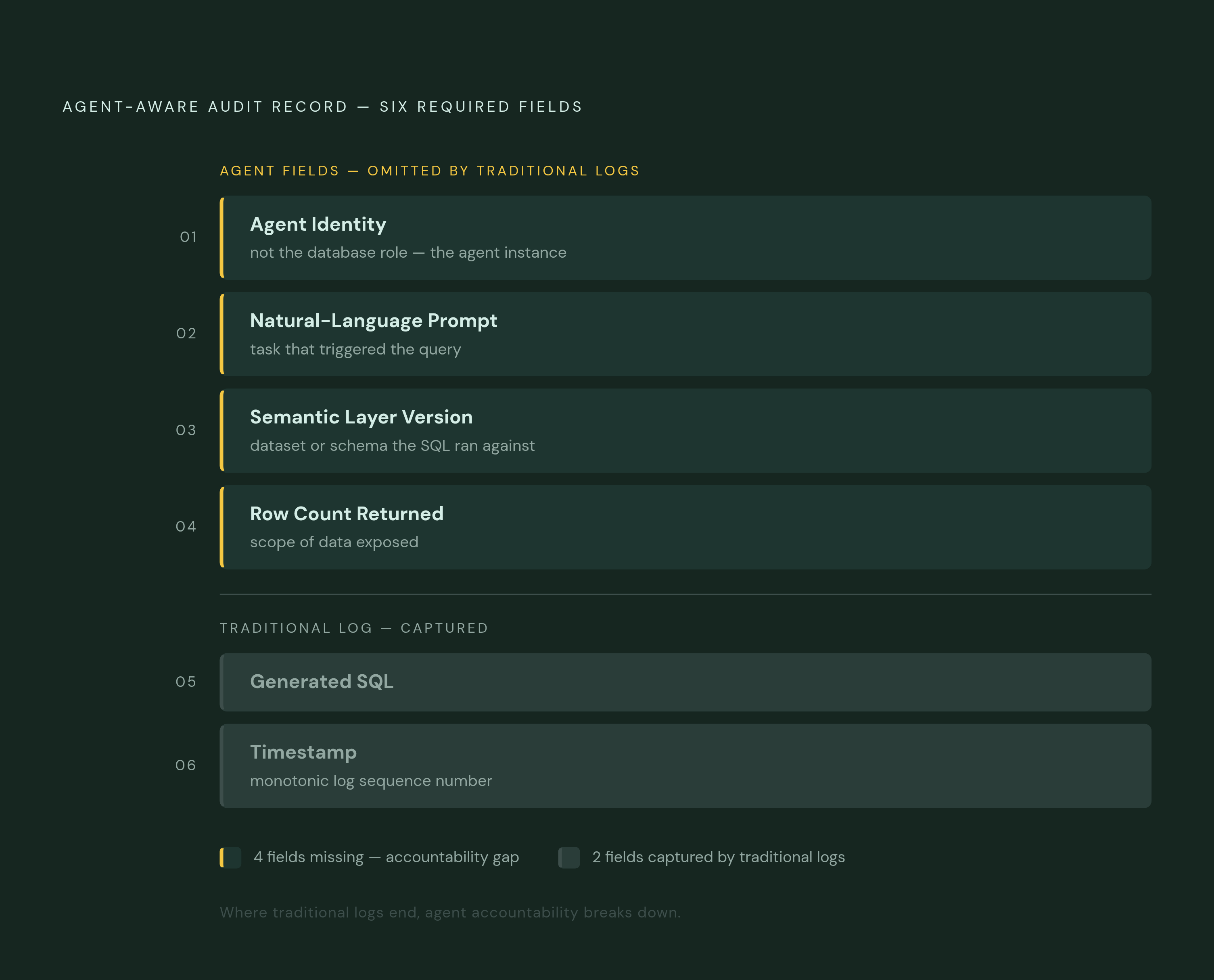
An audit trail built for agent workloads has to record more than the SQL statement that ran. It needs the full chain from the prompt that triggered the query, through the plan the agent built, to the execution itself, because a traditional database log was never designed to capture that chain.
A complete record for each query needs to include the agent's identity, not just the database role it happened to run under, along with the natural-language prompt or task that set the query in motion, the generated SQL itself, the specific version of the dataset or semantic layer it ran against, how many rows came back, and a timestamp tied to a monotonic log sequence, so the log catches drift while it's still small instead of only explaining a problem after it happened.
The integration layer underneath this has to be observable itself, or none of it works. When an agent's action fails silently for one customer, someone has to be able to see why it failed, because "it worked in the demo" doesn't hold up against a production support queue, and the same logic applies to a wrong answer that looks, on the surface, like a successful query returned correctly. For AI-generated dashboards and reports specifically, a three-layer model covers the risk well: lock the agent to a curated semantic layer with metrics and dimensions that have already been reviewed, require a human to review the first version of any new dashboard before it ships, and log every prompt-to-SQL pair behind it. That log is what makes the human review reproducible later and what makes the dashboard defensible if a board member or an auditor asks where a number came from.
How Dreambase implements this model for Supabase teams
Everything described above, governed datasets, enforcement that happens before a query runs, a shared semantic layer, logs that carry agent identity rather than a generic role, is a lot of infrastructure to assemble from pgAudit and a dashboard tool alone. Most Supabase teams don't have a data engineering function sitting around to build it, which is exactly the gap a platform purpose-built for this model is meant to close.
The identity gap described earlier stops being a problem once agents query pre-governed datasets tied to one consistent definition of authenticated identity, rather than inheriting whatever role happened to issue the underlying SQL. Extending Postgres with a modeled, access-controlled analytics layer is what turns an agent's audit trail from a list of statements into something that actually answers the question "who did what, and why." Pre-calculated, governed metrics, defined once and shared identically across human teammates and AI agents, remove the semantic ambiguity that makes an audit log misleading in the first place: when an agent queries "MRR," it's reading the same pre-modeled number the CEO sees in the weekly report, not a third figure assembled on the fly from whichever tables it happened to join.
Dreambase extends a Supabase project into this kind of governed analytics layer without requiring an ETL pipeline, a schema change, or a separate data warehouse to stand up and maintain. One shared data layer, read the same way by people and by the agents acting on their behalf, is what makes an audit trail worth having in the first place, rather than just a growing pile of logs no one has time to read.