The Contract Surface an MCP Analytics Server Enforces so Supabase Production Receives Zero Agent Traffic
Six contract clauses keep AI agents off your Supabase production database.
Sponsored by Dreambase, which builds a governed analytics and observability layer for Supabase.
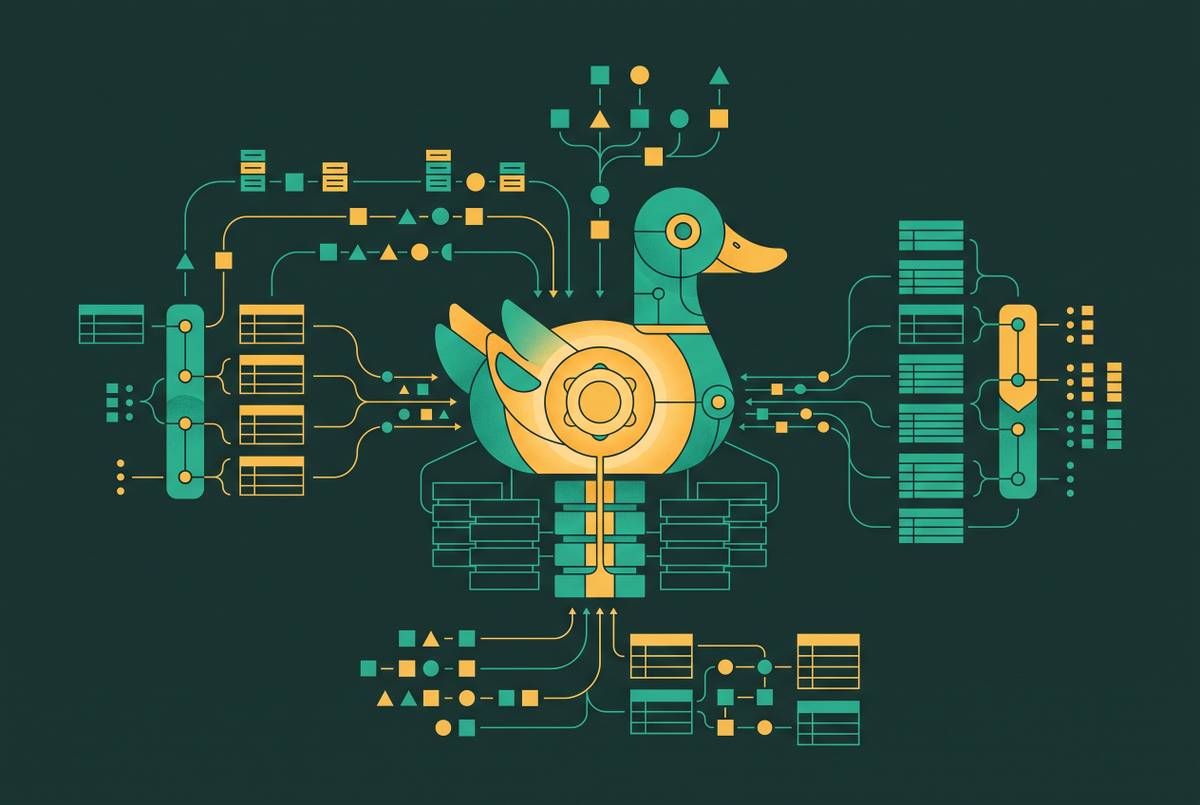
AI agents can query Supabase data without direct database access when an MCP analytics server exposes a governed analytical copy. Production receives zero agent traffic only when that server enforces a complete contract covering credentials, operations, datasets, statement inspection, masking, and tenant scope. Routing queries elsewhere is not enough if the agent retains a path back to production.
Why Supabase production databases are structurally exposed to agent traffic by default
Supabase auto-generates a REST API from the Postgres schema. Supabase now requires explicit grants, so a new table is not reachable through that API until someone grants access to it. Every grant still widens the reachable surface, and grants added during development are easy to forget. Tables created through SQL or migrations have Row Level Security disabled by default, so access can be granted before anyone makes an explicit row-access decision. The anon key cannot bypass RLS, but granted tables with RLS disabled are fully accessible to it. The service_role key crosses a different boundary because it bypasses all RLS policies and represents a highly privileged database role.
Agents make bursty requests and explore schemas, consuming connection slots in less predictable patterns than the database was sized for. Without a connection pooler, Postgres max_connections can quickly be exhausted. Supabase services, including Auth, Storage, PostgREST, and the health checker, consume connections from the same total, leaving fewer slots available for agents. Founders and early-stage teams are particularly exposed because rapid adoption of agentic workflows can precede having a dedicated data team watching for anomalies. The gap is architectural.
What an MCP analytics server actually is and why “contract layer” is the right frame
An MCP analytics server receives agent requests, translates them into governed queries or tool calls, fetches data from a controlled surface, and returns consumable results. It is neither a database driver nor an ETL pipeline. The Model Context Protocol is an open standard separating the client, which is the AI agent, from the server, which provides connection and control, and the resource, which is the database or dataset. That separation creates a distinct enforcement point.
The contract consists of explicit interface terms. These terms determine which tools exist, which statements are permitted, which datasets are visible, and what is logged for each call. Schema discovery, typed parameters, and structured errors give agents a defined interface. Connector logic resides at the server, allowing the same controls to apply to any MCP-compatible client.
Supabase’s official MCP documentation recommends avoiding production data, keeping the server inaccessible to customers, using read-only mode when appropriate, scoping access to a project, and reducing the attack surface with feature groups. The complete contract has six clauses, namely credential isolation, read-only tool surfaces, schema-exploration moderation, session-layer guardrails, data masking, and tenant isolation.
Clause one: credential isolation that keeps production keys off the agent layer
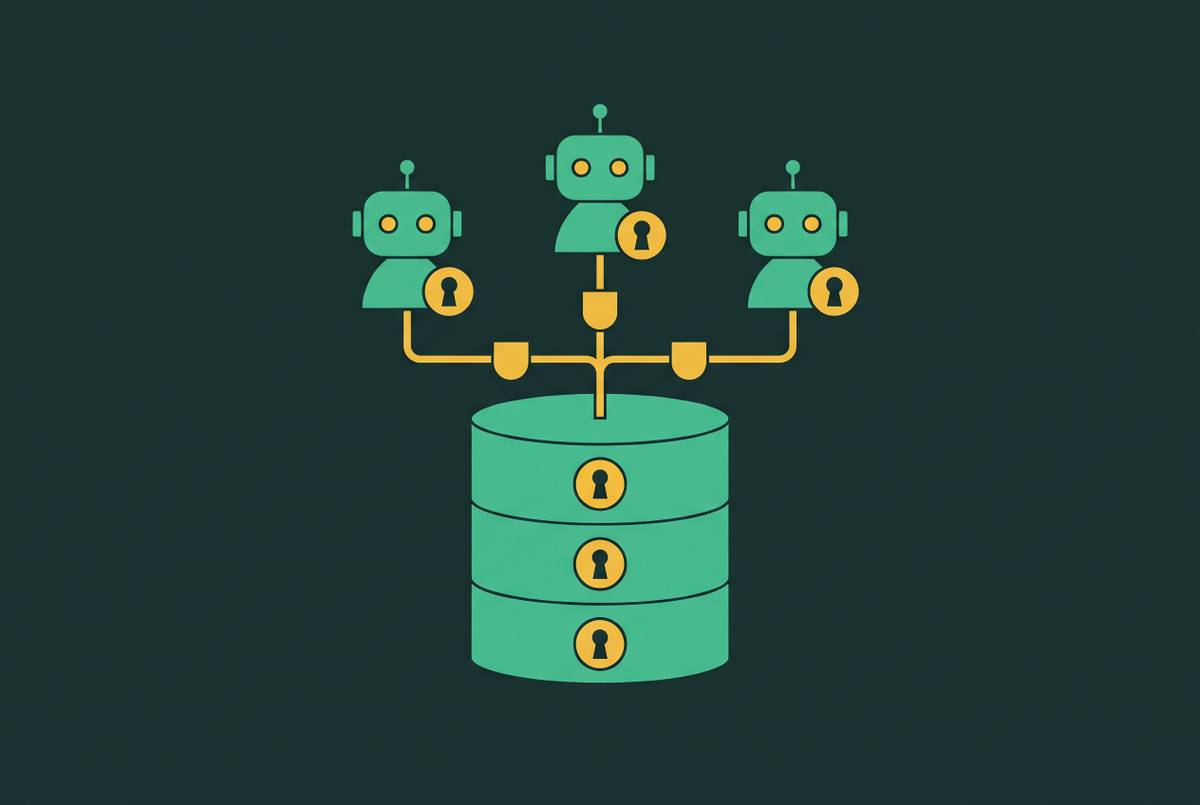
Credential isolation begins with what the agent never receives. The MCP server holds the required credentials, while the agent has no path to construct or retrieve a production connection string. Analytical requests go to a governed copy of the data. The server exposes that analytical layer without giving the agent credentials it could use to bypass the interface and define metrics against production tables.
The selection criteria follow from that separation. A suitable interface has explicit scope, governed metric definitions, an auditable access path, and no production credential at the agent layer. The AWS reference architecture published in November 2026 moves access control from shared credentials to tool-level controls at the MCP server. This keeps data safe without relying on each agent to manage credentials correctly. Where real credentials are required, the server injects them only after policy checks pass.
An agent holding a service_role key can bypass RLS, while a direct production connection exposes the connection pool to agent traffic. Controls on the governed interface cannot constrain a request that goes around it.
Clause two: SELECT-only tool surfaces that make write operations structurally unavailable
Credential custody determines who can connect, but the tool surface determines what the agent can request. A SELECT-only analytics interface excludes DDL and DML operations and rejects non-SELECT statements before execution. This is stronger than relying solely on a read-only database role. A grant can change inadvertently, while a restricted interface does not acquire a write operation merely because a database permission changes.
The AWS architecture enforces a SELECT-only SQL path before queries reach the data lake. Jivrajani, Alagappan, and Ganesan describe a similarly narrow environment in Sophrosyne at the CAIS’26 SAO Workshop. Its three capabilities are list_tables, describe_table, and read_query, supporting discovery and read-only exploration without DDL or DML. Merely omitting a tool named UPDATE would not establish the same contract if another exposed SQL tool accepted writes.
A 2026 security framework study of MCP tool inventories reports that action tools made up well under a third of inventories in late 2024 and nearly two-thirds by early 2026. Yet SELECT-only access remains insufficient because unconstrained reads against production can still exhaust connections and expose sensitive data.
Clause three: pre-modeled datasets that prevent agents from exploring the production schema
A read-only agent can still ask the wrong question of the wrong tables. Fine-grained APIs invite agents to inspect irrelevant schema elements and incorporate them into query construction. The Sophrosyne authors document how this over-exploration degrades accuracy. Their proposed directives augment API responses with guidance that constrains later exploration. A governed semantic layer goes further by giving agents access to approved analytical definitions.
The distinction is one of authority. With pre-modeled datasets, the agent queries metrics that already exist in the governed layer rather than constructing novel, unauthorized aggregations against production Postgres. “Revenue” has the same definition for a human and an agent because its meaning resides in the model. This makes modeling both an accuracy control and an access boundary.
Traditional BI ties metric definitions to individual tools, while headless analytics centralizes them in a shared semantic layer accessible through open APIs such as MCP. A definition change can then propagate from one place. The AWS architecture extends that approach to dataset onboarding through one JSON metadata file covering schema, business context, and column semantics, plus an optional context mapping entry. Adding datasets then takes a metadata change without opening another path to production.
Clause four: session-layer guardrails that inspect every statement before it reaches any database
Approved datasets do not make every possible query acceptable. Database grants and row policies establish access rights, but they cannot judge the context or intent of a request. A valid read can still load hundreds of thousands of rows or participate in a chain of tool calls whose combined results expose more than any single call. Statement inspection must therefore be a live gate before execution.
Short-lived identity tokens separate agent authentication from database passwords. The MCP server or proxy holds the real credentials and injects them only when policy checks pass. hoop.dev illustrates this mechanism as an inline Postgres wire-protocol proxy that can pass, mask, block, or escalate queries for review. Its production-query inspection demonstrates the guardrail mechanism, a separate architectural property from production workload isolation.
Prompt injection also reaches this control boundary. Tool descriptions flow from server to client, and a compromised server can embed hidden instructions that redirect the agent’s intended behavior. The AWS architecture places Bedrock Guardrails at the model boundary, while coverage at the MCP layer requires additional tool-boundary validation hooks. Grounding checks and prompt-injection blocking must apply to connected agents rather than depend on each agent’s own safety implementation.
Clause five: in-memory data masking that prevents sensitive fields from entering model context
Even a query that has been approved and inspected can return unsafe content. Result rows may hold customer emails, phone numbers, card numbers, or national IDs, which enter the model’s prompt context when the agent reads them. A question about revenue trends, for example, does not need individual email addresses.
Masking closes that gap on the response path.
The location of this control is decisive. Delegating masking to the agent means the agent has already received the sensitive value, while downstream logging controls cannot undo its entry into context. Without response-path masking, private data can reach external model logs or agent chat histories outside the organization’s data governance perimeter.
Clause six: tenant isolation enforced before the query is built, not filtered after the answer is generated
The previous clauses constrain operations and returned content, but tenant isolation determines whose data a request may reach. Moving access from a dashboard to an agent should preserve the user’s authorization context. It should not create a new superuser. An agent that reads across all customers and then filters its answer in natural language has already crossed the boundary before producing its response.
Tenant context must therefore precede query construction. The MCP layer injects scope from verified identity rather than trusting an agent-authored WHERE clause to define access. The AWS federated architecture establishes identity through Amazon Cognito, which authenticates the user and issues an identity token that travels with the request to the agent layer. That provides verified context before any query is built. The governed query path must keep that context when it selects data.
Masking cannot substitute for this authorization boundary. A SELECT-only, session-inspected query can still break tenant isolation even when every sensitive identifier has been redacted. The answer may contain the intended tenant’s figures while concealing an unauthorized cross-tenant read underneath. The violation lies in query scope.
What breaks when any single clause is absent
Without credential isolation, the agent can go around the controlled interface. With isolated credentials but write-capable tools, the interface still permits modifications. Removing write operations closes that path, but without governed datasets, an agent with read-only access can still explore production schemas and get answers wrong.
Without session inspection, agents can read too much from governed datasets and combine results across tool calls in unexpected ways. Without masking, even results that pass inspection can bring sensitive values into model context. Masking without tenant isolation redacts fields without correcting unauthorized scope. No clause repairs the absence of another.
Small teams face the same dependency chain. A single agent holding a service_role key can expose production whether it runs at a ten-person startup or a large enterprise, so the architectural gap does not shrink with headcount. Connection exhaustion is the first observable production failure when agent exploration consumes slots needed by application traffic. Chained tool calls can also expose data because results that are allowed on their own can become unsafe when combined.
How a governed MCP analytics layer covers the six clauses
One MCP server exposes a governed semantic layer. Pre-calculated metrics stored as governed Parquet datasets and queried through DuckDB provide the analytical surface. With a SELECT-only tool interface, modeled metrics, and tenant-scoped datasets, this design can cover the operation, dataset, and tenant clauses together, and agents never receive production credentials.
Statement inspection and response-path masking are separate controls. Pre-modeling narrows what an agent can ask for and what fields exist to return, but it is not the same as inspecting each statement or redacting values in flight. When choosing a server, check whether it performs those two controls itself, and add an inspecting proxy or a masking step where it does not. Parquet and DuckDB provide the query surface to which the contract applies, while the server prevents agent requests from finding an alternative route to production.
For Supabase teams, the distinction is between retaining Postgres as the analytical home and making it the agent’s query endpoint. The intended pattern requires no ETL pipeline, schema changes, or new infrastructure while serving agent requests from the governed layer. Zero agent connections is the production-side criterion. An MCP server selected for Supabase must preserve all six clauses across every callable path as datasets, metrics, and clients change.
Sources
- Sophrosyne: Agentic Exploration of Relational Data Systems Needs Moderation
- From silos to insights: Federated data access patterns for AI agents
- A Formal Security Framework for MCP-Based AI Agents: Threat Taxonomy, Verification Models, and Defense Mechanisms
- Serverless MCP server for AI agent data lake access on Amazon ECS Fargate