Promotion Gates That Make Governed Metric Snapshots the Only Supabase State an AI Agent Can Resolve
A promotion gate makes validated snapshots all an agent can query.

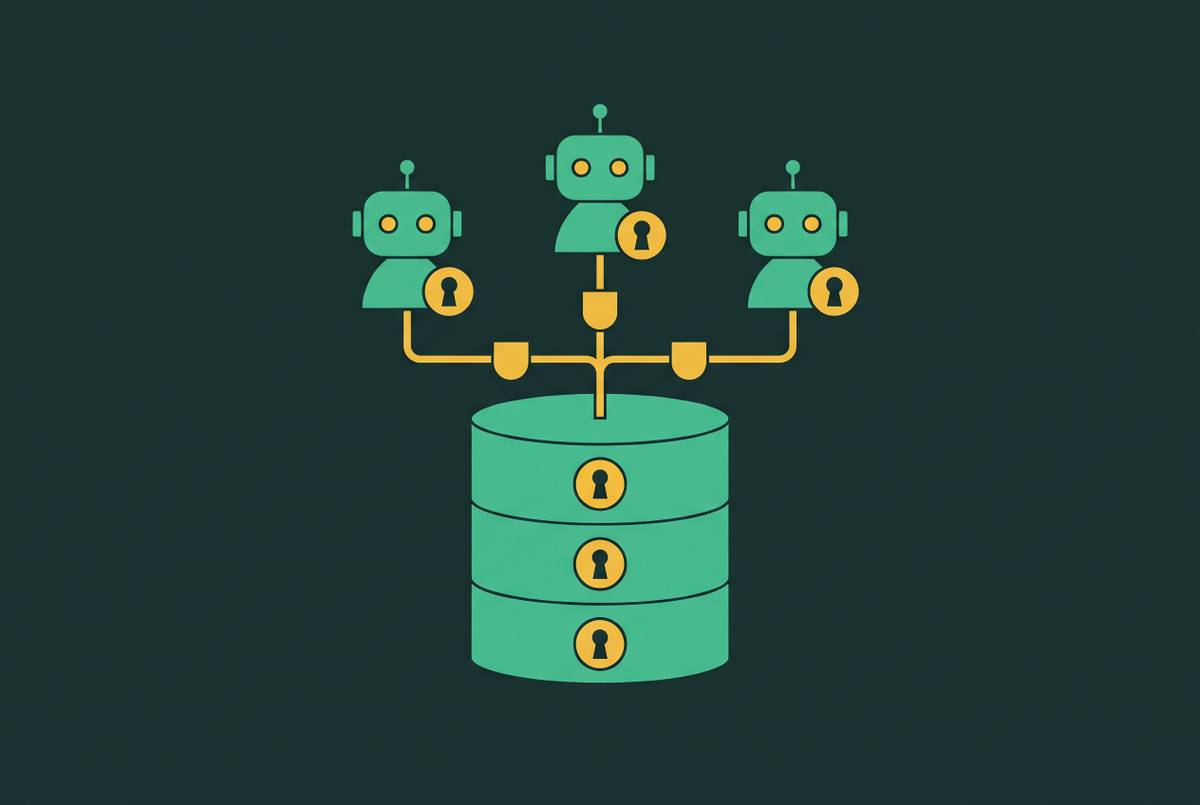
Governed data access for AI agents on Supabase requires a promotion gate that makes validated, versioned metric snapshots the only data an agent can resolve. A single access-controlled MCP server exposes those snapshots with role-level permissions enforced before access.
Why AI agents querying Supabase production databases directly is an architecture problem, not a policy one
Postgres is the single source of truth for Supabase state, including user data, auth tokens, Realtime subscription and authorization metadata, and storage metadata. An agent querying it directly therefore reaches live transactional state. If several tables offer plausible definitions of revenue, access permission does not establish which definition the agent should use.
A human analyst may ask which definition applies or flag the uncertainty. An agent can select a table and act without surfacing the conflict. Instructions to use trusted metrics leave that structural ambiguity intact because the connection still exposes competing states. Direct analytical queries also share the connection pool serving transactional traffic, where saturation can remain invisible until requests time out. What does the architecture need to make one stable state the only state an agent can reach?
What a promotion gate is and what work it actually does
A promotion gate is a conditional checkpoint through which data advances from raw to curated to served. Advancement depends on defined quality, freshness, completeness, and lineage checks. The gate does not merely label a dataset as trustworthy while leaving every alternative accessible. Its purpose is to make the served tier the only tier an agent can reach.
The raw tier contains direct Supabase table state, which is mutable, unvalidated, and operationally live. The curated tier contains modeled and checked data that has not yet been surfaced. It remains in flight through the gate. The served tier contains versioned, validated data exposed through the governed interface. Those distinctions separate data that exists from data that has earned the right to support an answer or decision.
Readiness must therefore be an explicit, surfaced state. Freshness establishes whether the data meets the required time condition, while quality, completeness, and lineage supply the other criteria for promotion. The architecture can give that guarantee only when an agent can reach promoted data alone, with no way to choose another table to get around a failed or incomplete check. Once that boundary exists, runtime enforcement becomes a question of preserving it.
How do AI agents query Supabase data through MCP without direct database access?
A governed MCP server preserves the boundary by giving every agent one access-controlled interface, regardless of the LLM behind it. Agents discover available datasets and request them by name through Resources and Tools. The server exposes only the served tier and is structurally incapable of routing agent requests backward through the gate. A separate connector for each agent would undermine this design if it reopened access to raw state.
The served tier takes physical form as pre-calculated, governed Parquet datasets queried through DuckDB. These datasets are produced only after the gate’s checks have passed, and their versions provide stable snapshots for resolution. Agent queries run against that analytical copy. Identity and permissions at the connection restrict the metrics and rows each role can see, rather than relying on the model to filter its own results. The bounded served tier also makes spend more predictable when query volume is driven by agents.
The July 28, 2026 MCP specification revision made the protocol stateless at the protocol layer. Protocol version, client identity, and capabilities travel with each request in a _meta parameter, so requests can reach any server instance behind a plain round-robin load balancer. Horizontal scaling can now work without session affinity. That protocol behavior supports a scalable access interface, but it does not itself create the promotion guarantee. The guarantee comes from what the server exposes and which routes it cannot take.
What breaks when the gate is absent: metric drift and security regression
Without a governed definition, one engineer can calculate SUM(revenue) while another calculates SUM(amount_captured). Both queries can read records that are correct, but the Q2 revenue figure changes with the query. The disagreement is semantic. Adding an agent creates room for a third interpretation without a human necessarily flagging the conflict. A promotion gate addresses that failure before reasoning begins by surfacing a validated metric snapshot.
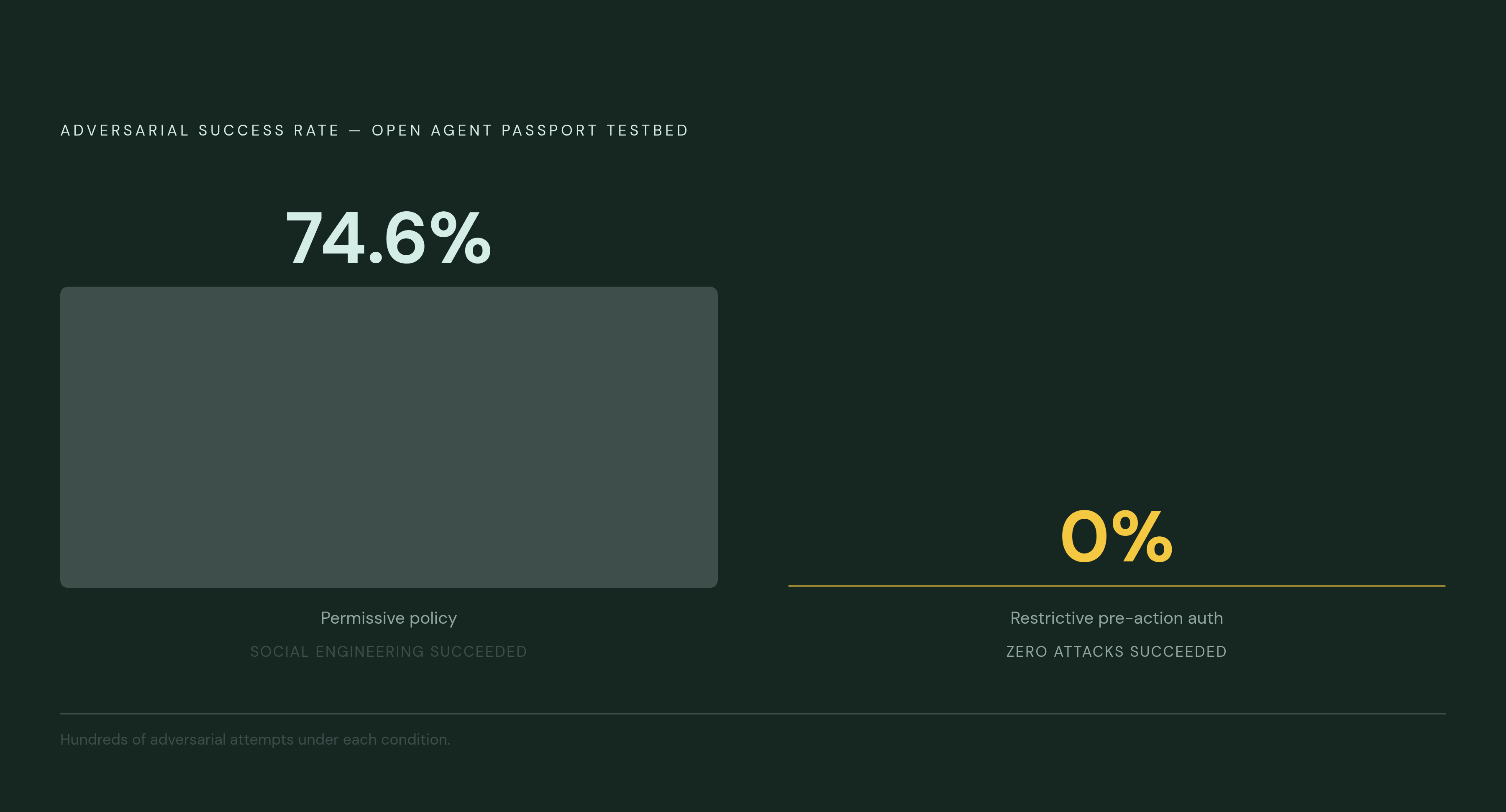
The access failure follows the same pattern. If the infrastructure leaves a permissive path open, how the model behaves is the last thing that can stop a request from being carried out. The Open Agent Passport paper reported that social engineering succeeded 74.6% of the time under a permissive policy in its live adversarial testbed. With a restrictive pre-action authorization policy in place, adversarial attackers had a zero percent success rate over hundreds of attempts. These results demonstrate the consequence of changing the enforcement policy within that testbed.
Every agent-data interaction should be recorded automatically in structured transcripts collected by the system. Tamper-proof provenance cannot depend on the caller’s account. The same enforcement point that applies security constraints can also enforce quality gates and operational contracts, so the record of access is part of the governed path from the start.
Why pre-action authorization at the gate level is different from sandboxing or model alignment
Sandboxing and model alignment address different parts of the problem. A sandbox contains the blast radius of execution, but it does not establish whether a request should reach a dataset in the first place. Alignment shapes behavior. Model-based screening remains probabilistic, so training-time behavior cannot guarantee that a particular tool call against a live table produces a governed result. Neither control substitutes for restricting access to promoted state.
A role can be permitted to read rows without those rows representing a validated, versioned metric snapshot. Authorization and readiness are distinct conditions for access. The promotion gate adds the data-tier boundary, while pre-action authorization evaluates whether the particular request is allowed. The served tier still needs row-level restrictions because some callers may lack the right to read a promoted dataset.
Pre-action authorization intercepts the tool call synchronously before execution, evaluates it against a declarative policy, and produces a cryptographically signed audit record. The paper measured a median enforcement decision of 53 ms across a thousand decisions. That measured cost makes deterministic enforcement operationally practical. The promotion gate extends the same logic to the data tier by preventing requests from reaching anything the MCP server does not expose.
How the gate applies the same logic to founder metrics that it applies to agent queries
The same ambiguity affects founder decisions when sales, finance, and product maintain separate versions of ARR. An executive team can spend its decision-making time reconciling numbers. A dashboard does not resolve that disagreement by itself. A metric promotion gate requires a figure to earn its place in the governed layer before it reaches either decision-makers or agents. The ARR figure on the CEO dashboard and the figure in an agent’s context window then come from the same versioned snapshot.
For teams using this approach, every metric on the CEO dashboard should match a single source. ARR comes from the billing system, cash from the bank, and product usage from the analytics warehouse. The source anchors the metric’s governed definition. The snapshot layer does that reconciliation automatically, saving each consumer from doing it by hand. It also separates agreement about the number from the choice of interface used to display it.
Metrics should be calculated ahead of time and pushed to where people work, including inboxes, Slack, and an agent’s context window. Push delivery depends on validation before distribution. The gate supplies that condition by requiring the figure to pass its checks before it becomes available to those destinations. A governed layer decoupled from any single front end can expose the same numbers through MCP, an API, or direct query. Those paths must serve only the governed snapshot.
What Supabase teams need in place before the gate can function: observability as a prerequisite
Freshness, quality, completeness, and latency must be visible enough for the checkpoint to evaluate them. Observability gives the gate the signals it needs to run its checks. Without those signals, “ready” is only a label.
A Supabase team needs at least slow query logging and connection and pool metrics to run the gate. Slow query logging shows regressions in the data before users have to complain. Pool metrics reveal saturation before it becomes timeouts. When agents’ analytical work shares a pool with transactional traffic, those metrics give an early warning that the architecture needs a governed analytical copy. They also make the cost of retaining the direct production path visible.
These operational signals do not replace the dataset checks. A healthy connection pool does not prove that a metric is complete, fresh, or traceable, so the gate still needs explicit verification of its promotion criteria. Observability should be installed from day one to expose production degradation before scale makes it conspicuous. Its purpose is to expose whether the conditions for promotion are met. Observability tells the system when data is ready, while the gate gives that readiness consequence by controlling what becomes accessible.
Building the governed snapshot layer on a Supabase project without a dedicated data team
An early-stage Supabase team can operate the governed snapshot layer as managed infrastructure above its existing project rather than treating it as a reason to hire a dedicated data engineer. The layer begins with pre-modeled Parquet datasets built from Supabase Postgres and promoted only after the gate’s criteria are cleared. DuckDB provides the query surface over those files, so agent requests do not place analytical query pressure on the production connection pool. A single MCP server exposes the promoted datasets with role-level visibility.
In a managed arrangement, the team does not need to build ETL pipelines, change the existing Supabase schema, or manage new infrastructure itself. The data work still has to happen. A managed partner performs the four jobs in order, which are moving the data, modeling it, analyzing it, and governing it. The distinction is between removing that work and operating it as a service. The snapshot layer extends the project’s analytical capability without requiring changes to what is already running.
The service must produce versioned datasets, show when they meet the gate’s readiness checks, expose only promoted state, and enforce role-level access at the interface. A generic MCP connection is not enough. If it can route agent requests to production tables, the structural guarantee is absent even when the connector supports permissions. The governed snapshot must instead be the shared source for the board dashboard, Slack alerts, and agent queries, with no alternate path through which an agent can resolve ungated state.