MCP-Driven Analytics Delivery to AI Assistants and Agents
Governed metrics layers ensure agents query accurate, secure data through standard protocols.

MCP-driven analytics delivery gives AI assistants and agents a standard way to query data, but trustworthy answers depend on the layer behind the server. For API-first and agent-first teams that want full API control without an opinionated frontend, the architectural fit is a headless analytics backend exposing certified metrics through governed endpoints. MCP provides connectivity, while the backend supplies consistent definitions, access controls, and isolation from production workloads.
Why MCP became the default channel between AI agents and data systems
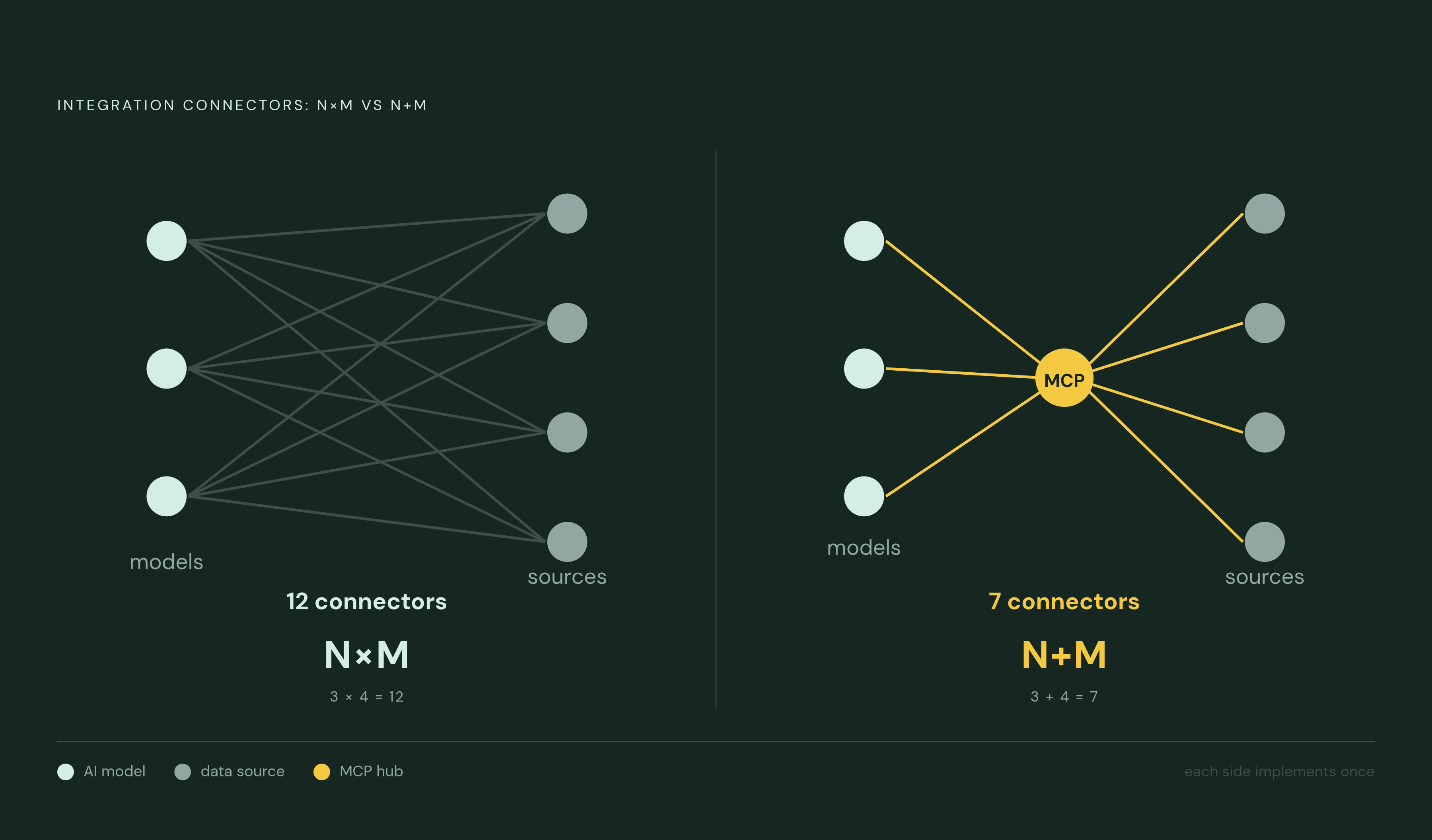
To connect AI applications to data sources, teams once had to build a separate integration for each pair. With N models and M sources, that meant N×M connectors, each with its own authentication, error handling, and drift risk. MCP reduces the integration pattern to N+M because each client and each source implements the same protocol. The engineering benefit is direct and practical. Teams can connect another compatible application without rebuilding every source integration to fit how that application works.
Anthropic released the Model Context Protocol in November 2024. By December 2025, it had donated the protocol to the Agentic AI Foundation under the Linux Foundation, giving MCP vendor-neutral standing under the same neutral governance model as Kubernetes. Its architecture has three roles, the host AI application, the client that manages connections inside that host, and the server that exposes capabilities. Communication uses JSON-RPC 2.0. Those roles separate the application using a capability from the connector that makes it available.
The server exposes three primitives, which are Tools, Resources, and Prompts. Tools execute actions such as database queries and API calls, Resources provide read-only context such as schema records and catalog entries, and Prompts supply reusable interaction templates. Existing APIs still perform the underlying work. MCP gives AI applications a standard way to discover and invoke those capabilities. Unlike REST, MCP maintains a client-server session across requests, supporting multi-step analytical workflows, but the standardized channel does not prescribe the quality or meaning of the data it exposes.
What MCP exposes and what it deliberately leaves ungoverned
An MCP server can expose raw tables, ungoverned APIs, or carefully modeled metrics. All are compatible with the protocol. Compliance therefore establishes that an agent can communicate with a server. A successful query can still produce a confidently wrong answer through a hallucinated metric, an ambiguous aggregation, or a definition that conflicts with what the business needs to know.
Consider an agent asked to report revenue. Raw tables might lead it to gross revenue, net revenue, recognized revenue, or ARR, depending on which data it reaches. Syntax cannot settle that choice for the agent. Each query might run correctly while answering a different question from the one that was asked. Without a certified definition, a valid result can hide a semantic error that stays hidden even when the protocol works and the query runs successfully.
Asking for clarification helps with one question at a time, but shared definitions are still needed. Agents running continuously across many workflows cannot stop for human disambiguation every time a metric name has several meanings. Tasks, the asynchronous pattern introduced in the MCP specification, let agents return a handle and continue working in the background. In an ungoverned system, definition errors can therefore compound across an operation.
The protocol’s scope is limited to making capabilities available, leaving decisions about which business concepts need certification and which calculations to use for them to the backend. That neutrality leaves an explicit responsibility for the backend. The data layer must resolve naming conflicts and metric definitions before agents use them at scale, rather than treating the model’s interpretation as the final authority.
The security and access-control problems that appear the moment agents hit production data
Access to production data brings risks of its own, even when calculations are correct. A human analyst opens a manageable number of files each day, while an agent can operate continuously and orders of magnitude faster. Manual approval flows cannot match that pace. The architecture needs to restrict what agents can reach and what their queries can return.
The principle of least privilege means keeping production database credentials out of agent configuration. Analytical queries should pass through a gateway that enforces permissions and logs access. Protection must also cover the returned data. Row-level security and column-level masking can let a fraud detection agent inspect transaction timestamps and amounts while withholding payment card numbers at query time. Attribute-based access control extends that approach by considering the query’s context alongside the agent’s identity or static role.
MCP ecosystem data records 30+ CVEs against MCP implementations in January–February 2026, ranging from path traversal to the CVSS 9.6 remote code execution vulnerability CVE-2025-6514 in mcp-remote. Prompt injection remains unsolved at the protocol level. Mitigation belongs in the server implementation and the controls behind it, so adopting the standard does not remove the need to secure the deployment.
These risks support careful architecture when adopting MCP. A governed gateway can make access more visible because every analytical query is structured, logged, and attributable. That creates a useful compliance asset. Through the governed interface, teams get a common audit trail of what agents do, in place of separate ways to grant access that rely on people.
How a governed semantic layer behind the MCP server closes both the correctness and safety gaps
A governed semantic layer defines metrics, entities, and calculations before an agent asks a question. Revenue has one certified calculation, so the agent no longer has to choose among columns that could fit. The model no longer invents the metric’s logic. For equivalent queries with the same permissions, agents use the same definition no matter which model or workflow made the request. This addresses correctness at the point where meaning enters the system.
That separation is the basis of headless analytics. Business logic belongs to the backend rather than to a particular dashboard or other frontend, so custom applications, Slack bots, dashboards, and agents can consume the same definitions. No prebuilt dashboard UI is required for access. A team adding usage analytics to an AI agent can expose modeled metrics through the governed interface without making a visual reporting product the gatekeeper for those metrics.
Pre-calculated, modeled datasets are the appropriate unit of delivery. Through MCP, an agent can inspect available metrics and dimensions, query them, and receive structured results without touching the raw tables from which they were derived. Access restrictions become part of that path. When the server exposes only the governed layer and the agent has no production credentials or alternate database route, raw production tables are outside its reach.
The stack still has distinct responsibilities that should not be conflated. MCP supplies connectivity, a retrieval mechanism such as RAG finds relevant context, and the governed semantic layer supplies verified ownership, lineage, freshness, and access policy. Retrieval alone does not certify a business definition. Likewise, a standardized tool call cannot show whether a result is up to date or whether access to it is authorized.
With pre-calculation, metrics are computed before the request comes in, so the agent does not have to work out every result from raw SQL at query time. That can make governed responses faster. The same design also limits the amount of analytical interpretation delegated to the model, because validated calculations are available before the interaction begins.
Why Supabase projects need this architecture wired in before agents arrive, not after
Supabase provides a capable Postgres backend and a native MCP server, but those capabilities do not automatically define governed analytics. Supabase also released app-embedded MCP at its Select 2026 event, allowing a product to expose its own MCP server as an Edge Function. Every tool call runs as the authenticated user under existing RLS policies. That is a substantial access-control foundation for applications. However, RLS on a production table determines which rows a user can see, while certification of a revenue calculation remains a separate business decision.
A production Supabase MCP architecture follows a hub-and-spoke pattern, with a centralized server brokering tool calls between agents and Supabase services. That provides a natural place for governed delivery. The broker still needs modeled datasets to expose rather than simply forwarding analytical access to raw tables.
Supabase’s observability capabilities address another distinct need. The platform processes billions of log events daily, exposes ~200 Postgres metrics in a monitoring-system-compatible format through its Metrics API, and supports agent prompts for scheduled health, security, and performance checks. These capabilities support visibility into database operations. They do not, by themselves, create certified business metrics on top of the database. An agent inspecting system health and an agent reporting business performance need different governed context.
Scale makes the separation more consequential. High-traffic Supabase systems still require query tuning, connection management, indexing, workload isolation, and cost control. Analytical queries against the production primary add pressure that connection pooling alone cannot absorb, while read replicas help with load but expose the same ungoverned tables. Multigres, Supabase’s multi-node operating system for Postgres, adds HA, connection pooling, and eventual sharding. Released as an alpha in June 2026, it was not production-ready as of September 2026, so teams could not yet rely on horizontal write scaling to absorb analytical load.
Establish the governed layer before deploying analytical agents. Otherwise, direct access to production Postgres accumulates query-pattern debt, security exposure, and conflicting metric definitions as agent usage grows. Retrofitting the boundary becomes harder after that dependency forms. Wiring it in early lets the project’s existing access controls support an analytical interface with definitions and a place to run its workloads chosen from the start.
What should a headless analytics backend expose through MCP?
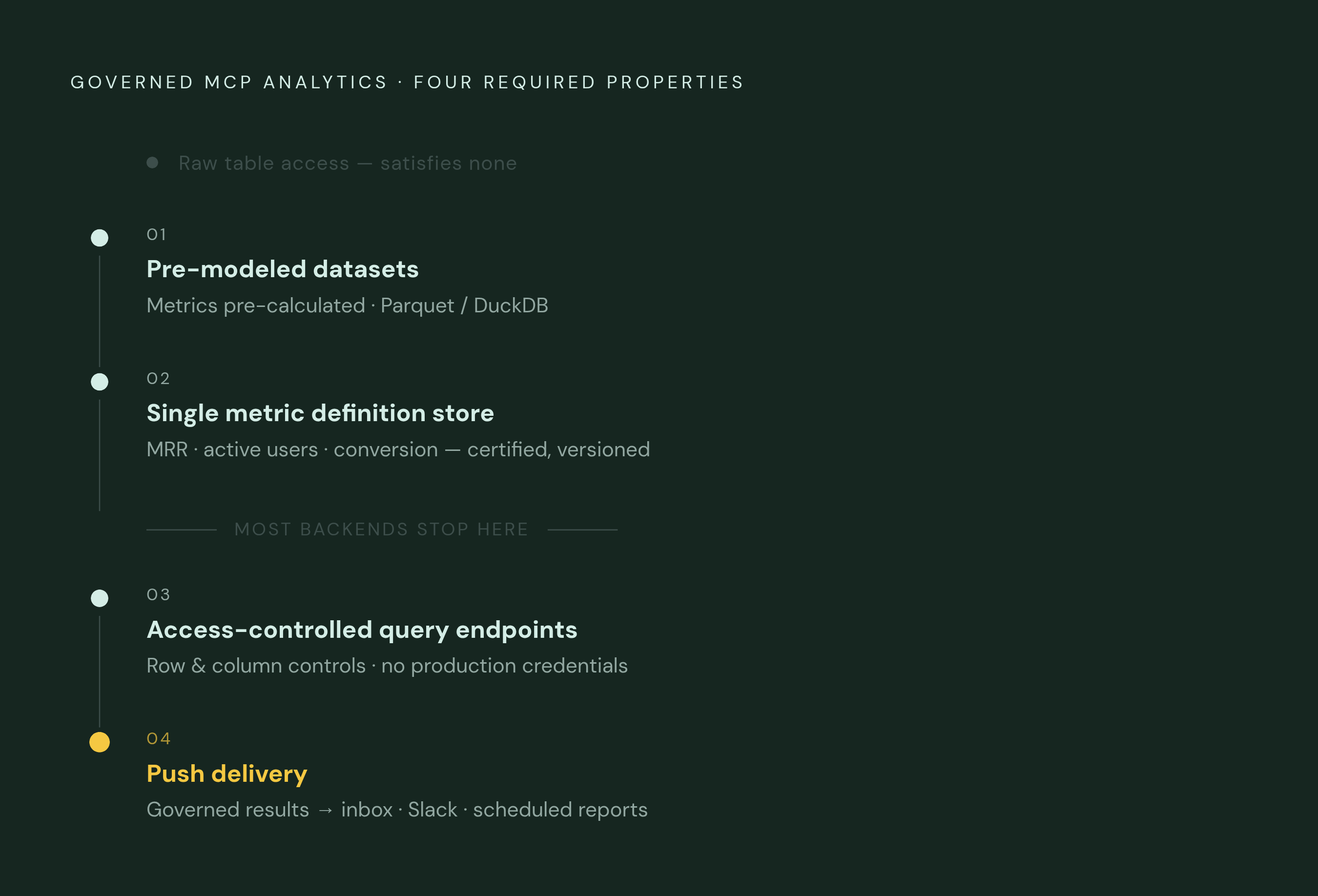
A governed MCP analytics layer needs four properties, namely pre-modeled datasets, a single metric definition store, access-controlled query endpoints, and push delivery. Together, they provide concrete selection criteria for teams seeking full API control without an opinionated frontend. A backend that exposes tables but leaves metric construction to each consumer provides only the access component of a governed analytics architecture.
Pre-modeled datasets contain metrics and dimensions calculated ahead of time in a format optimized for analytical queries, such as Parquet queried through DuckDB. Agents consume certified numbers rather than generating ad-hoc SQL against production tables. The metric store supplies their shared meaning. MRR, active users, and conversion rate belong in one place where their definitions are certified and versioned, so disagreements are settled at definition time.
The endpoints should enforce row-level and column-level controls in a way that keeps consumers from going around them. Agents get analytical access while production database credentials stay out of their reach. The MCP server should also be the single interface for human-facing tools and AI agents, with one access policy and one audit log. A founder, a Slack bot, and an autonomous agent can then query the same MRR definition. Lineage and freshness complete that context by showing when the metric was calculated and which source records produced it.
Governed results should reach inboxes, Slack, scheduled reports, and dashboards refreshed on schedule, so staying informed does not depend on remembering to ask. Push delivery serves a different purpose from query access. Query access lets humans and agents look into specific questions using the same certified metrics that teams receive through their existing work channels.
For Supabase teams, this design treats Postgres as the analytical home and extends the existing project rather than making another frontend the center of the architecture. Certified Parquet datasets queryable through DuckDB provide the serving format, while the production database remains outside the agent’s query path. That boundary also provides workload isolation. Analytical queries run against the governed datasets rather than competing with transactional work on the primary, allowing the architecture that enforces trustworthy access to limit production pressure as agent usage grows.