Governing Which Metrics Agents Can Reach When MCP Is the Analytics Interface
Agents need governed metric definitions, not just valid credentials.

When MCP becomes the analytics interface, access governance must reach beyond the system boundary to the metrics an agent can use. A valid credential does not establish what “Revenue” means or authorize every way of calculating it. Trustworthy agent analytics requires pre-modeled, semantically governed datasets that define each metric, constrain its use, and give humans and agents the same numbers.
Why MCP as an analytics interface creates a governance problem that system-level access control cannot solve
Analytics governance inherited from the BI era starts with who can log in and what their role permits. That boundary is inadequate when an agent can choose its own analytical path through a connected system. Authentication establishes permission to enter the interface. It does not establish which metric definition the agent should use, which dimensions it may request, or whether its answer follows an approved calculation.
This is already an architectural problem. Anthropic launched MCP in November 2024 and donated it to the Agentic AI Foundation under the Linux Foundation in December 2025. Bain’s Technology Report 2026 describes its growth to more than 20,000 servers in under two years as a shift toward a de facto standard. Governance thinking has not kept pace with that adoption. Even with a secure connection, an authenticated agent can skip approved metrics and query raw tables without a semantic contract.
How MCP actually works as an interface layer, and what it deliberately leaves unresolved
MCP gives agents a standard way to call tools and access resources through three parts: the AI client, the MCP server, and the underlying resource. The client is the agent or assistant, while the server handles authentication, retrieval, and formatting in front of a database or API. These components have distinct responsibilities by design. The interface can make a tool available without defining what its data means or deciding whether its output is an approved business metric.
API wrappers move data on a schedule, while MCP lets agents ask questions about data in real time. That immediacy exposes gaps in definitions as soon as a question crosses them. The 2026-07-28 stateless specification also removes session-level state from the protocol, allowing any request to land on any server instance. Identity, query jobs, and access approvals need durable systems rather than a session on which subsequent calls implicitly depend.
The same specification introduces Mcp-Method and Mcp-Name headers, which let gateways route and authorize requests using method and tool names. Those headers provide an enforcement point for tool budgets, but they do not supply the policy or metric definition being enforced. MCP does not decide which table is trusted. The data platform must provide semantic grounding, lineage, query performance, cost controls, and auditability before agent calls go live, rather than leaving the agent to assemble those guarantees after retrieval.
The semantic bypass risk: what happens when agents reach raw tables instead of governed metrics
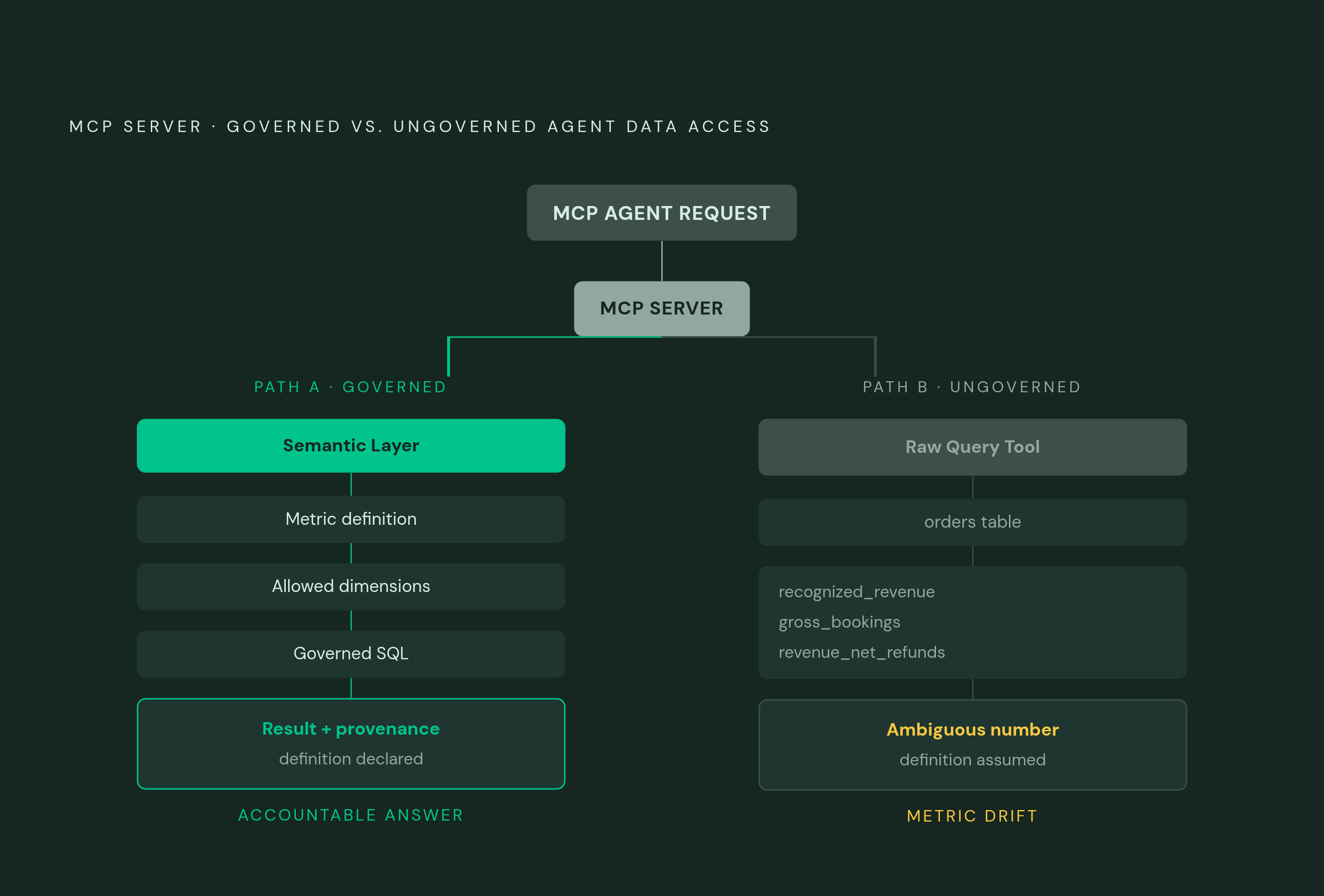
Semantic bypass occurs when an agent uses raw query tools to bypass approved metrics. An orders table may contain enough data to calculate several plausible versions of “Revenue,” including recognized revenue, gross bookings, and revenue net of refunds. The table alone cannot tell the agent which one to use. If the agent makes an assumption without exposing it in the answer, a precise-looking number can conceal a disagreement about the business itself.
Semantic context without query access creates the opposite limitation, because the agent can describe a metric but cannot answer a question about it. The tool layer must connect definitions and execution. Without that connection, the same KPI can return different values depending on the agent, the table it reaches, and the assumption it makes. This is metric drift, which agents speed up as their queries cross naming conflicts and permission gaps and bring them to light.
Analytics agents may generate many short-lived calls across metadata, definitions, query engines, and workflow systems, accumulating costs without metric-level controls. A logic bug, unexpected input, or prompt injection can corrupt production data, which makes read-only access a structural safeguard.
The UK ICO has asked for evidence of how organizations deal with the data protection risks of agentic AI, making agent behavior part of a growing debate over regulation. That review does not by itself set a metric-governance standard. However, an answer derived outside the semantic layer lacks lineage back to an approved definition, even if the underlying query can be traced.
Why pre-modeled, semantically governed datasets are the right unit of analytics access for agents
A pre-modeled, pre-calculated dataset gives the agent an analytical contract that sets out how to use the tables and limits how it can interpret them. What its metrics mean, their lineage, and their allowed dimensions are clear before a call is made. The semantic layer centralizes those definitions and calculations. “Revenue,” “Churn,” and “Active User” become named measures with canonical meanings, rather than calculations reconstructed separately by each consumer.
That layer can translate application requests into governed SQL, execute them against the data store, and return results with their definitions attached. The agent does not need the underlying table structure. When a calculation changes in this shared layer, dashboards, agent responses, and automated reports all get the same changed definition. This prevents each interface from becoming a separate authority on how a business measure is calculated.
For that contract to be usable, an analytics MCP server needs to expose semantic resources and query tools together. The agent retrieves the metric contract, asks for permitted dimensions, runs a governed query, and receives provenance with the response. Allowed dimensions are part of the access boundary. An agent cannot request “Revenue by employee salary band” when that dimension is absent from the metric’s governed definition, so enforcement does not depend on the agent judging the request correctly.
Provenance connects the returned number to the definition used, the calculation timestamp, and the lineage back to its source. That context makes the answer accountable as well as readable. Pre-calculated datasets also change the economics of retrieval. DuckDB queries over Parquet are fast and cheap, giving the governed dataset an operational advantage over repeated live-table access as well as a semantic one.
What metric-level access control looks like in practice: identity, scope, and read-only by default
Operationally, the lesson is to register each agent as a named identity with an owner, a purpose, allowed connectors, and a defined scope of permitted metrics. Traditional role-based access control can be too coarse for agents that need temporary permissions for particular tasks, so purpose-bounded access provides a closer fit. OAuth or SAML identity passthrough lets an agent act within the end user’s existing permissions.
Identity registration also needs records outside protocol sessions that can be audited. The 2026-07-28 specification deprecates dynamic client registration in favor of Client ID Metadata Documents, while retaining the former for backward compatibility. The platform still has to connect that identity to the metrics and actions authorized for its purpose.
Tinuiti provides a named production example of metric-level governance through MCP, establishing that this is not merely a speculative architecture. A team deploying analytics agents should inventory their data sources, define row- and column-level policies, and expose governed services, keeping direct database credentials out of agents’ reach. Every agent query should then be audited, while gateway controls use the method and tool headers to enforce rate limits and budgets for the exposed metric tools.
Read-only access should make analytics writes structurally impossible by default. Writes need a different approval model from reads. For example, a database migration server can find schema changes, check what they affect, and require the user to approve them before they run. Keeping that workflow separate prevents the permissions needed for a deliberate change from becoming incidental privileges of an analytics agent.
The Supabase-specific governance surface: what the MCP server exposes by default and how to close the gaps
The Supabase MCP server is broader than a Postgres reader, so its default surface does not match a read-only analytics role. Depending on configuration, it can inspect schema, execute SQL, apply migrations, query logs, generate types, deploy Edge Functions, manage development branches, and perform account or project operations. It is not read-only by default, even for analytics use.
For analytics workloads, the minimum safe configuration is read_only=true, which runs database queries through a read-only Postgres user and removes mutating tools from the permitted surface. Credential choice must support that restriction as well. The service role key bypasses Row Level Security entirely. Day-to-day agent queries should use a read-only database role rather than the service role, so the access design does not defeat the policies intended to constrain it.
Supabase’s native observability surface through MCP, shipped in August 2026, includes query_logs for structured access across API, Auth, Storage, Edge Functions, and Postgres logs. A project-scoped, read-only health agent can check API and Auth errors and Postgres connection pressure once per hour using query_logs and read-only execute_sql. Live Postgres statistics, including bloat, cache hit rate, locks, and slow queries, remain available through read-only execute_sql.
Concurrency likewise does not require restoring protocol session state. A hub-and-spoke topology with a centralized MCP server brokering tool calls, pinned to Supabase MCP server v0.18.0 with connection pool max 50, handles many concurrent agents with p95 latency under 300ms. An agent reading raw Postgres tables can still make up a revenue definition under read_only=true, so analytics access also needs a semantic layer behind the MCP interface to make sure queries follow approved metric contracts.
What governed metric access looks like for a startup without a dedicated data team
For an early-stage team, the underlying data often already exists across a product database, Stripe, and a CRM. What is missing is an agreed definition of “Churn” or “Active User” that survives the move between those systems. This is a trust problem. Agents bring it to light sooner because they query all the time, while people may query only when they prepare a weekly review.
The practical response is a data dictionary in which every metric has a single source of truth, an agreed definition, and a calculation that a local query cannot override. Small teams need that discipline before agents are live. Retrofitting it later is harder because the missing contract already affects the answers people receive. A governed data layer that handles modeling and access control lets a team do this without building a warehouse or taking on a custom semantic-layer project.
That layer should also deliver metrics where people work, including inboxes, Slack, and scheduled reports. Calculating ahead of time and distributing proactively reduces reliance on humans or agents remembering to pull the latest numbers. Delivery should not create another place to define them. The same governed calculation should feed those messages and the MCP tools that agents can use.
“Revenue” in a founder’s inbox and “Revenue” in an agent’s context window refer to the same calculation, defined once. Trust comes from that common authority.